
Social Studies 6 (Period 1) Assignments
- Instructor
- Samantha Weiss
- Terms
- 2018-19 Trimester 1
- 2018-19 Trimester 2
- 2018-19 Trimester 3
- Department
- Social Studies
- Description
-
Welcome to Ancient Civilizations course of study with Ms. Weiss. We will look at civilizations and how they developed during the period of 10,000 BCE to 500 CE. We will look at the different civilizations that first emerged on our planet. These civilizations all developed along rivers where they learned to farm after being hunter-gatherers for so long. This agricultural revolution allowed languages and villages and religions and laws to begin to form. It will be so fun to explore how early humans began to organize themselves together.
Files
Upcoming Assignments

No upcoming assignments.
Past Assignments
Due:
Assignment
Due:
Assignment
Due:
Assignment
Minimum day with all 6 periods before lunch.
Lunch 11:50-12:35
Students then report back to period 6 to be
escorted by period 6 teacher to Ris Tix Rally.
Due:
Assignment
Due:
Assignment
Due:
Assignment
Due:
Assignment
Due:
Assignment
Due:

Assignment
Due:
Assignment
Due:
Assignment
Due:
Assignment
Due:
Assignment
- What sport will be new in the 2024 Olympic Games?
- What altitude did a dog attain by following climbers high up into the Himalayas?
- What is the magazine that was returned to a library many years later with $100 and a letter of apology?
- What household item do Americans consume almost half of the world’s consumption of?
- What country does not admit that it has nuclear warheads
- What are the 3 countries with the most nuclear warheads?
- Name two famous people who are implicated in the college admissions scandal.
- Name one argument for why social media is helping democracy.
- Name one argument for how it is hurting our democracy.
- After reading the article above it Islam, what are three things you learned?
Due:
Assignment
Due:
Assignment
Due:
Assignment
Due:
Assignment
Due:
Assignment
Due:
Assignment
Due:
Assignment
Due:
Assignment
Due:
Assignment
Due:
Assignment
Due:
Assignment
Due:
Assignment
Due:
Assignment
Due:
Assignment
Due:

Assignment
Due:
Assignment
Due:
Assignment


Due:
Assignment
Due:
Assignment
03/11/19 // Our Agenda
1. Work on the Ancient Greek Philosophers handout in your notebook. Use the back of the handout and your textbook. You may work with a neighbor if your teacher is ok with that!
2. Handout the Greek Map activity. BRING your colored pencils to class by Wednesday. You'll need them.
3. Be good for the sub.
Due:
Assignment
Due:
Assignment
Due:
Assignment
Due:
Assignment
Due:
Assignment
Due:
Assignment
Due:
Assignment
Due:
Assignment
Due:
Assignment
Due:
Assignment
Due:
Assignment
Due:
Assignment
Due:
Assignment
Due:
Assignment
Due:
Assignment
Due:
Assignment
Due:
Assignment
Due:
Assignment
Due:
Assignment
Due:
Assignment
Due:
Assignment
Due:
Assignment
Due:
Assignment
Due:
Assignment
Due:
Assignment
Due:
Assignment
Due:
Assignment
Due:
Assignment
Due:
Assignment
Due:
Assignment
Due:
Assignment
Due:
Assignment
Due:
Assignment
Due:
Assignment
Due:
Assignment
Due:
Assignment
Due:
Assignment
Due:
Assignment
Due:
Assignment
Due:
Assignment
Due:
Assignment
Due:
Assignment
Due:

Assignment
Due:
Assignment
Chapter 4, Section 1 Questions and Chapter 4, Section 2 Questions
- Lower Egypt is located along the Nile River delta.
- The Nile delta was ideal for settling because it had a lot of rich soil and it was near the Mediterranean Sea.
- The Nile’s cataracts helped Egypt because it created a barrier against their enemies and it could also hurt them because it was impossible to navigate and use as a transportation channel.
- a. The foods the Egyptians ate were fish, plants and wild animals. Yummy!
- The Nile’s role in Egyptian diet was to provide fish, duck, geese, and to water the crops for all the veggies.
- The desert to the west and east of Ancient Egypt helped the civilization to develop in peace because they created a natural barrier to enemy invaders.
- a. The first pharaoh of Egypt was perhaps Menes. Some say that Menes may be a mythical pharaoh.
- The pharaohs of the first dynasty wore a double crown to symbolize the unification of lower and upper Egypt.
Chapter 4, Section 2 Questions
1.a.The phrase “Old Kingdom” refers to the period of 500 years from 2700 BCE to 2200 BCE.
1.b.The pharaoh’s authority was never questioned because they thought he was the god Horus. Therefore, the pharaoh was the people’s link to the gods. His holy role made them fear him. This helped him to assert his or her power.
1.c.I think the pharaoh’s might have wanted the support of the nobles (rich people) because this will give the pharaoh great power. The only people who could afford weapons to overthrow the pharaoh would be the nobles. If he or she had the nobles’ support then he or she was safe from assassination. Also, the pharaoh needed help from the nobles to run the country.
2.a. The Egyptians thought that the afterlife is a place where your soul goes when you die for all eternity. The gods will test you at the entrance and if you pass the test then it’s a really great place. Everyon
2.b. Embalming was important to the Ancient Egyptians because it prepared the person for their afterlife.
3.a. Engineering is the science of architecture. It is very practical.
3.b. The building of the pyramids tells us about Egyptian society because we learned that there is a tomb inside. There are hieroglyphs also all around that tell us the stories of the pharaohs. It also tells us that the Egyptians wanted to get closer to their gods. They were also very advanced and organized to be able to pull off such a huge undertaking. They were very smart.
Due:
Assignment
Due:
Assignment
Due:
Assignment
Due:
Assignment
Due:
Assignment
Due:
Assignment
Due:
Assignment
Due:
Assignment
Due:
Assignment
Due:
Assignment
Due:
Assignment
- Crops grow well in Mesopotamia because of water & rich soil
- From what land features is Mesopotamia named?
- Sequence of how civilization evolved: common sense!
- Study the key terms! Surplus means EXTRA!
- Specialization of jobs is synonymous with "division of labor"
- Canals are man-made but rivers are natural waterways
- Canals were built to irrigate the land
- Civilizations developed as a result of a steady food supply that led to people settling down
- City-states fought each other for good farmland
- Sargon I was the first military leader to use bows & arrows
- Ur was the most powerful city-state
- Priests were supposedly communicating between the people & the gods
- The social hierarchy is shaped like a triangle because at the top there are the fewest (the rulers...) while at the bottom are all the peasants/farmers and then slaves
- Know the social hierarchy
- Cunieform were wedged shaped symbols
- Ziggurats were tall in all likelihood to honor the gods
- Phoenicians grew powerful through trade, not battle
- Phoenicians used the sea to trade because of mountains in the region
- Carthage was a city-state
- The Phoenician alphabet spread along the trade routes...
Due:
Assignment
- Go over questions for Ch.3, Sections 1, 2 & 3
- If time, go over the 10 laws that we studied from Hammurabi's code: their purpose...
- CHAPTER 3 TEST: Thursday, October 18th. There will be a "Jeopardy" review game on Wednesday, October 17th that gives lots of hints for the unit test.
- IXL? Loose Ends? Start Chapter 4!
Due:
Assignment
- Loose Ends: Did I finish my clay project? (Ms. Weiss is so done with the messy clay project...Last day to get that done...) Did I finish Hammurabi's Code - explaining the purpose of 10 of the laws...? Did I finish my Chapter 3 questions? Do all of my assignments have titles & dates? Have I written down all of the agendas?
- IXL Demo Project
- We ended up in the library bc of construction
Due:
Assignment
Due:
Assignment
Due:
Assignment
Due:
Assignment
Due:
Assignment
Due:
Assignment
Due:
Assignment
Due:
Assignment
Due:
Assignment
Due:
Assignment
Due:
Assignment
- Permission Forms? Please tell me you remembered!
- Finish any work that was due today!
- Finish the Otzi the Iceman Chart
- Index cards - on our new Unit. Yay! 28 Words! P. 55
Due:
Assignment
- Collect the Permission Forms again! Don't forget that it is due by tomorrow!!!
- Make a chart like this in your notebook
- Title the chart Otzi the Iceman
- Otzi the Iceman movie https://youtu.be/BXLSDIU-Eus
|
What makes this find so miraculous and important?
|
Draw a picture of Otzi
|
|
Draw a picture of the most sophisticated tool found with Otzi here
|
Draw another item found with Otzi here
|
Due:
Assignment
- Notes?
- Writing down agendas?
- Answering JE's? (Climate Change? Symbols of our Culture?)
- Answering Chapter Section Questions? Ch.2 Sections 1 and 3 [Q.1-4; Q.1-3]
- DDC - P. 27 - All 17 Words in a chart?
Due:
Assignment
- We will continue to work on Ch.2, Section 3 Q.1-3
- We will continue to work on the DDC p.27, 17 words!
- Permission forms for the California Science Center field trip will be distributed. Students will get a sour patch treat if they return the form to me by Friday. PLEASE PLEASE PLEASE get your permission forms in by this Friday so that you may take part in this amazing opportunity.
- Teachers will give you time to make up any work missed due to the field trip
- We will leave sometime after first period. You'll be called out of 1st period so be at school on time on October 4th.
- We should be back in time for the closing bell at 2:35 pm.
- Bring a sack lunch that day and snacks for the bus ride.
- No back packs on the trip! You'll have time to take your back pack to your locker before heading to the buses in the morning.
- You may bring your phones but be responsible with them!
- The trip is free but we need your permission form in order for you to attend.
Due:
Assignment
Due:
Assignment
Due:
Assignment
- Social Structure - small, nomadic groups that tended to promote equality throughout the group.
- Diet - The diet of hunter-gatherers was much more diverse than that of Neolithic humans, who ate only what they produced through farming and domesticating animals.
- Tools - hammer stones, stone cores, spears, stone flakes
- Daily Life - nomads who roamed the earth hunting and gathering. Likely spent 20 hours per week obtaining food.
- Social Structure - increase in food production led to higher populations, which resulted in the formation of villages and towns.
- Diet - Humans began to selectively plant cereal grasses that tasted good, such as emmer, einkorn, and barley. Plants with a bitter taste or with seeds that were difficult to grind were not planted.
- Tools - flint arrow heads, flint axes, stone flakes, scythes
- Daily Life - spent their days farming.
- Fertile Crescent - A crescent-shaped region that contains moist and fertile land. In the ancient world, it included Mesopotamia, the Tigris and Euphrates rivers, and the eastern coast of the Mediterranean sea.
- Domesticate - to convert (plants, animals, etc.) to domestic use.
- Neolithic Founder Crops - eight plants that were domesticated by early farming communities in the Fertile Crescent. These plants formed the basis of agriculture.
- Europe - northern Europe was covered with ice. Ice sheets went as far south as Germany and Poland. Further south, permafrost covered the land. Ice covered all of Iceland and almost all of the British Isles.
- Asia - There were ice sheets in Tibet, Baltistan, and Ladakh. Many smaller glaciers formed in Southeast Asia. Permafrost covered Asia as far south as Beijing.
- Africa and the Middle East - Many small mountain glaciers formed.
- Australia - the Australian mainland, New Guinea, Tasmania, and many other smaller islands were one land mass.
- North America - Ice covered all of Canada and extended to the Ohio and Missouri rivers. Ice caps covered the Rocky Mountains.
- South America - the Patagonia Ice Sheet covered the southern third of Chile. Ice sheets in various parts of South America often reached sea level.
Due:
Assignment
- Finish Notes during the retake
- Go over answers to Q's on p. 34
- The Agricultural Revolution: Popcorn Reading
Due:
Assignment
Due:
Assignment
- Reminders: Retake of Geo Quiz is tomorrow - study! It's optional but I will give you the second grade, whether it is a better grade or not!
- Finish Ch.2 Section 1(?)
- Answer Questions 1-4 on page 34. Restate the questions in your answers.
- The Agricultural Revolution - We went from being hunter-gathers to farmers.
Due:
Assignment
- Reminders: Turn in late work!?
- Finish Notes
- Read Chapter 2 together about Early Man
- HOMEWORK: Please finish the notes tonight that are on yesterday's edlio. AND there is a geography quiz retake on Thursday so you can study for that if you want!
Due:
Assignment
- Bathroom Sign Out Reminder! Please always sign out on the clipboard at the front of the room. Tell me, then sign out.
- Pass back work (and then give me back those Create a Maps to display please.) Do you still have work to show me? Turn it in!
- Notes & Go over pp. 14-15
- If time, share the JE on Symbols of Our Culture.
- Australopithecus - lived between 3.9 & 2.9 million years ago. Considered one of the earliest hominins. They have been found in savanna environments.
- Homo habilis - lived 2.8 million years ago. Some of the first hominins to master stone technology.
- Homo erectus - lived 1.8 million years ago. Look very similar to modern humans. Brains were 74% the size of modern man's. Earliest fire use and earliest exit from Africa.
- Neanderthals - lived 600,000 years ago. Closely related to modern humans - 99.5% the same DNA. Earliest cooking.
- Cro-magnons - lived 200,000 years ago. This term is often used to describe the first early modern humans that lived in the upper Paleolithic period. The body was heavy, strong, and muscular.
- Homo sapiens - anatomically modern humans. Evolved around 200,000 years ago.
Due:
Assignment
- Announcements: Sign out on clip board
- Finish notes from yesterday
- Geography Quiz
- Turn in Create-a-Map & Loose Ends (Go over Q. 1-4 on pp.14-15)
Due:
Assignment
- Pre-history is the time before written records
- Atlatl - a spear thrower
- Carbon dating - method for determining the amount of radioactive carbon left in organic remains, which determines the time of death
- Bipedal - the ability to walk upright
- B.C. = Before Christ
- B.C.E. = Before the Common Era <= We use this nomenclature now
- A.D. = Anno Domini ("In the year of the Lord" in Latin)
- C.E. = Common Era <= We use this nomenclature now
- Biological Anthropology - study the physical and biological aspects of humans and near-humans
- Cultural Anthropology - study the cultural aspects of human societies. These cultural aspects usually include social and political organization, marriage and kinship, economic patterns, and religious beliefs of societies
- Linguistic Anthropology - study communication and languages. They study the structure and function of languages, how languages develop over time, writing, and nonverbal communication.
- Archaeology - the study of human activity through analysis of material remains such as artifacts, architecture, and landscapes.
Due:
Assignment
- Check HW while students work on Create-a-Map
- Review the 4 hemispheres, and other map terms
- Quiz on Friday on Geography Terms
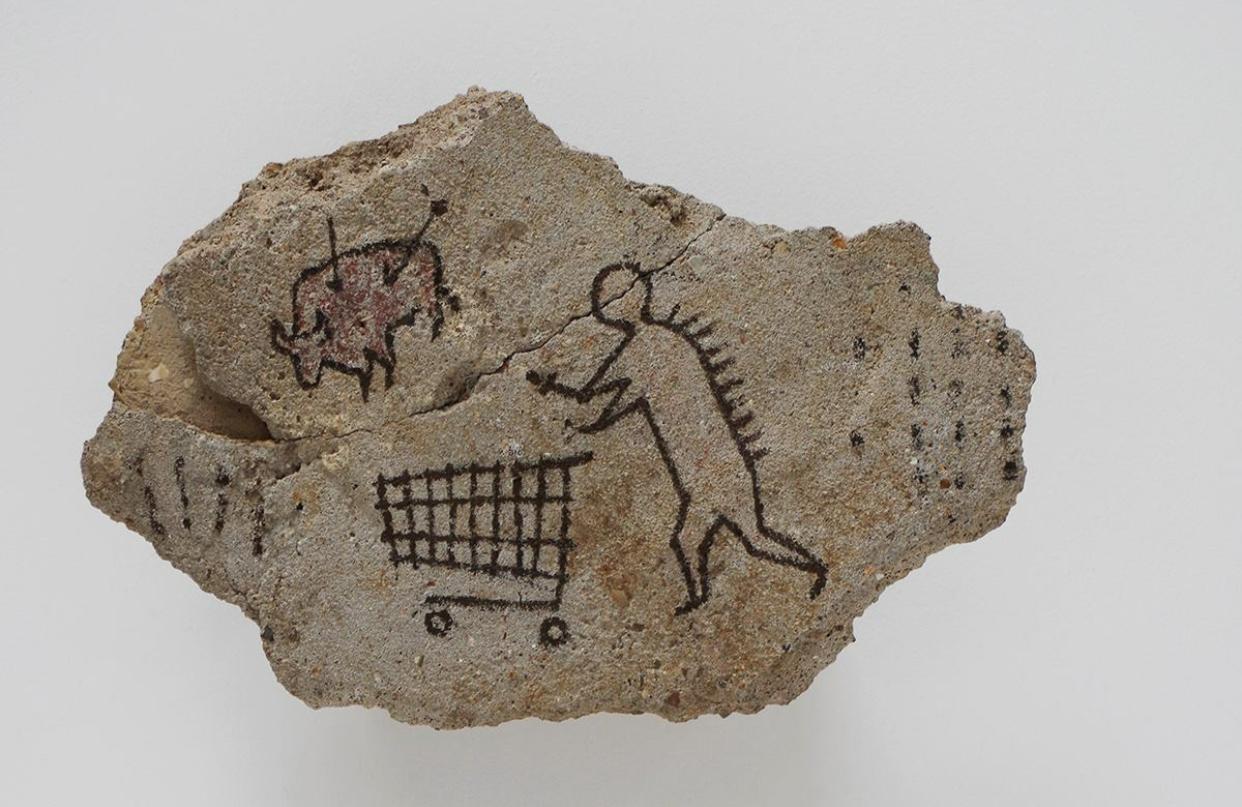
- JE: Symbols of My Culture In 2005, a very funny curator at the British Museum put this stone artwork on display in an Early Man exhibit. It took 3 days for the museum to become aware of this hoax. The picture made me think about how shopping carts may very well become obsolete someday, now that we can have almost anything delivered to our homes that we order from a computer. As historians this year, we will examine artifacts and read about how these artifacts give us a picture of what a culture was like a long time ago. If you could only draw pictures (symbols....) of what your culture is like today, what pictures would you draw (choose no more than 5)?
Due:
Assignment
- Reminders/Return NB’s
- Create a Map instructions
- Checking Notebooks
- Work on Create a Map with partner(s) We will have two class periods to work on this!
Due:
Assignment
- Finish up geography note cards(?)
- Work on Oceans & Continents worksheet.
- In textbook, complete map exercise on p. 14-15 Answer Q. 1-4 in your notebook.
- Create-a-Map Activity Explanation
Due:
Assignment
- Finish notes on vocabulary assignments; the first vocabulary assignment will be due on 08/30 - see below for details
- Reminder about getting all your supplies (please please please donate a box of tissues for the year).
- Current Events Topics: Journal Entry on School Safety
Due:
Assignment
Due:
Assignment
Due:
Assignment
- Period 2 Ice Breaker Game Board.docx
- Period One Answers to Who Knows Us Best.docx
- Period 3 Ice Breaker Game Board.docx
- Period 4 Ice Breaker Game Board.docx
- Period 4 Answers to Who Knows Us Best.docx
- Period Two Answers to Who Knows Us Best.docx
- Period Three Answers to Who Knows Us Best.docx
- Period 1 Ice Breaker Game Board.docx
Due:
Assignment
Sharing Questions – Place Answers on Index Cards
Name: __________________ P. ?